
AI Agents for Appointment Booking: A Small Business Guide

AI agents for appointment booking answer inbound calls, chats and forms, qualify the lead against your rules, then write the booking straight into your calendar. For most service businesses they pay for themselves by catching the after-hours and missed-call leads that used to go to a competitor.
If you run a clinic, a salon, a trades business or a law practice, this is the highest-leverage automation available to you right now. Here is what these agents do, what they cost, and where they fall over.
How does an AI booking agent actually work?
Four steps, every time.
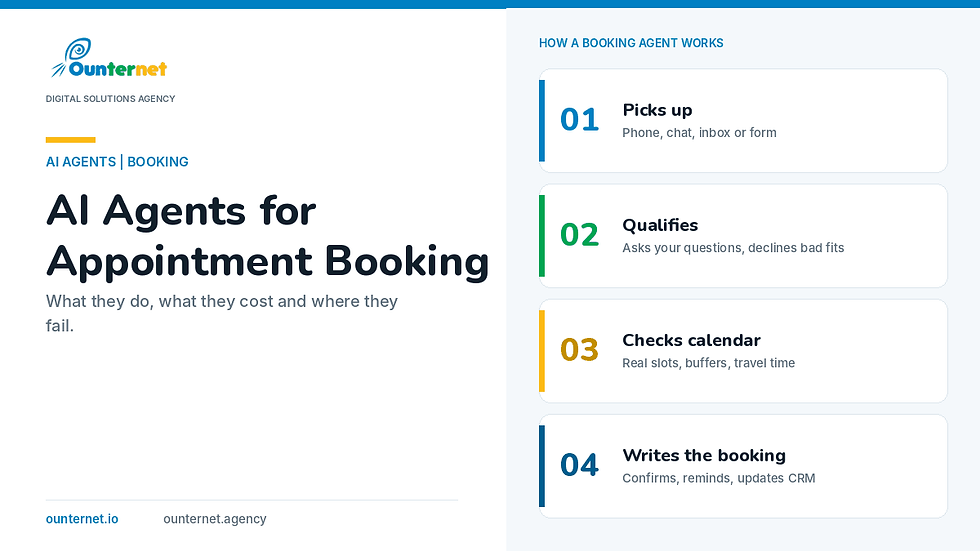
It picks up. Voice on the phone, chat on the site, a reply in the inbox, or a response to a form. Usually within seconds.
It qualifies. It asks the questions you told it to ask. Service type, location, urgency, budget range, insurance, whatever gates your calendar.
It checks availability. It reads your real calendar, applies your buffers, travel time and service durations, and offers only slots you can actually work.
It writes the booking. Creates the event, sends the confirmation, starts the reminder sequence, and drops the notes into your CRM.
The step people underestimate is the second one. A booking agent that schedules everybody is not helping you. A good one turns away the jobs you do not want as confidently as it books the ones you do.
What do AI agents for appointment booking cost?
Three tiers, roughly.
Built-in scheduling assistants inside tools you already pay for. Often included, or under fifty dollars a month. Limited qualification, fine for a simple calendar.
Off-the-shelf booking agents. Typically one hundred to five hundred dollars a month depending on volume, with voice costing more than chat because of per-minute charges.
Custom agents wired into your CRM, your quoting rules and your job types. A setup project plus a monthly run cost. Worth it when a booking is worth several hundred dollars and the qualification logic is genuinely specific to your business.
The number that matters is not the subscription. It is the value of one recovered booking. As an example, if your average job is worth eight hundred dollars and the agent catches three missed enquiries a month that would have gone elsewhere, the math is not close.
Which businesses get the most from a booking agent?
Simple pattern: the more of your leads arrive outside business hours, the bigger the win.
Home services and trades. An emergency call at 9pm goes to whoever answers it.
Clinics, dental and aesthetics. High no-show cost, heavy reminder needs, repetitive intake questions.
Legal, accounting and consulting. Long qualification, high value per booking, expensive people currently answering phones.
Fitness, salons and studios. High volume and low value per booking, so staff time spent scheduling is pure cost.
Where it works less well: complex B2B deals where the first conversation is exploratory and the buyer expects a person, or businesses with so little inbound that a plain calendar link would do the same job for free.
What can go wrong with an AI booking agent?
Four failure modes, all preventable.
Double booking. Caused by an agent writing to a calendar it cannot fully read. Fix it by giving it one source of truth and real buffers.
Booking bad fits. Caused by vague qualification rules. Be specific about what to decline, not just what to accept.
Sounding fake. Voice agents that oversell or refuse to admit what they are will annoy people. Let it say what it is and hand off quickly when asked.
No escape hatch. Every agent needs a clean route to a human within two exchanges. Without one you will lose exactly the leads that matter most.
The rule we use: the agent handles the standard path, and anything unusual goes to a person fast, with the full context attached.
How do you set one up without breaking your calendar?
Two weeks. Run it in this order.
Write the rules before you buy anything. What you book, what you decline, your hours, buffers, travel time, deposit policy. One page is enough.
Start on one channel. Usually web chat, because mistakes are cheaper in text than on a live call.
Run it in shadow mode first. Let it draft the qualification and the proposed slot, and you approve each one. Three or four days of this will expose every gap in your rules.
Turn on autonomy for the clear cases only. Widen the range once you trust it.
Measure two numbers. Response time, and booked rate from inbound. If those do not move, the agent is not your problem. Your offer or your traffic is.
Are AI booking agents worth it?
For most service businesses, yes. AI agents for appointment booking are one of the few automations with a payback you can calculate inside a single month, because the cost of a missed call is a number you already know. Start narrow, write the rules down, keep a fast route to a human, and expand from there.
If you want help scoping one for your business, book a call at ounternet.agency. We build AI agents into CRM and calendar setups. You can see more of our AI and data work at ounternet.io, or follow along on LinkedIn.
Related reading: AI Agents for Lead Generation: A Small Business Playbook and How to Use AI Agents to Automate Customer Service 2026.
Frequently asked questions
Can an AI agent answer my business phone?
Yes. Voice agents handle inbound calls, qualify and book. They cost more per interaction than chat because of per-minute pricing, so most businesses start with chat and forms, then add voice once the rules are proven.
Will customers know they are talking to an AI?
Many will, and that is fine when the agent is upfront and genuinely useful. Problems start when an agent pretends to be human and then fails an obvious question. Let it identify itself and hand off quickly.
Does an AI booking agent work with my existing calendar?
Almost always, if you use Google Calendar, Outlook or a mainstream scheduling tool. The harder integration is usually the CRM, not the calendar.


Comments